
History of Pulltabs
Published on:
Ducktabs continues a long tradition of in-pack chance promotions that trace their roots back over 100 years. The industry has evolved from a little known woodblock game all the way to the perforated pull-tab that is ubiquitous to the Wisconsin Tavern. Join us in exploring this exciting and fascinating history.
The origins of the pull-tab can be traced back to the punchboard. A punchboard was a device with a pattern of holes, each containing a slip of paper, covered by paper or foil to be punched by participants in the game. The slip was retrieved from the hole, with the customer winning money, or product, or nothing. Early punchboards were homemade, often from wood. Unscrupulous operators would rig the games since they made the game and knew where the big prizes were. Some didn't even put in the large prizes at all. Players caught on and largely stopped playing these games.
-
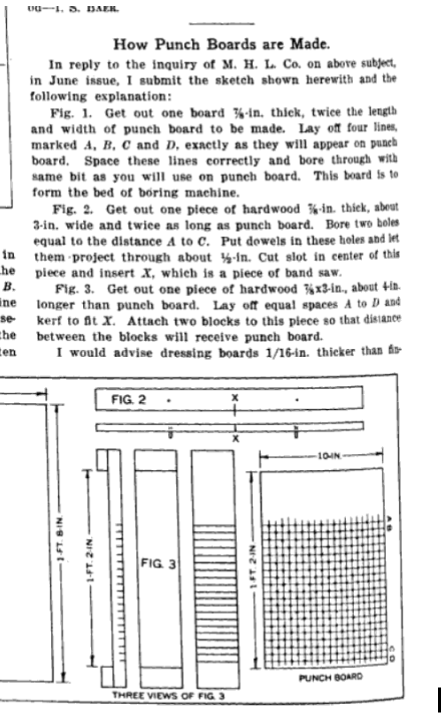
Method for making a punchboard shown in Woodworker magazine in 1923. -
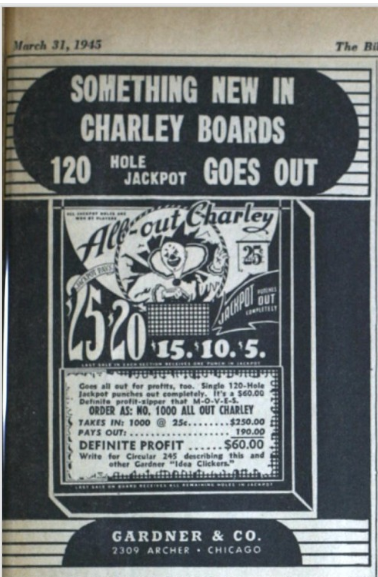
Magazine advertisement for Charley Boards.
By the late 1800's, manufactured cardboard and paper boards started to appear and the popularity of the games proliferated. These had sealed compartments that prevented tampering and kept the game fair. The players started coming back.
An early patent on a manufactured punchboard was in 1905 by C. A. Brewer and C. G. Scannell of Chicago. Automation of the process reduced costs, increased uniform quality, and allowed an explosion of punchboards across the country. It is estimated that 30 million were sold between 1910 and 1915, with over 50 million sold in in 1939 at their peak. By 1920 the punchboard was in widespread use in American taverns, drugstores, and beyond. Board manufacturers advertised in newspapers and magazines. Manufacturers seemed to be advertising heavily in Billboard Magazine in the 1940's and and 1950's. Two examples of this are seen below.
Disputes regarding the legality of punchboards can be found around this time in documents from the Missouri Court of Appeals (1919) and the New York Legal Record (1920). The popularity of the games grew around the country throughout the next several decades. In more populous areas, organized crime became involved due to their existing involvement in the tavern and gaming industries. In many jurisdictions, the boards were viewed as a relatively harmless form of entertainment and the operators were largely left alone.
Punchboards began to be used to promote products, notably Coca-Cola and Zippo lighters. Promotional punchboards allowed a struggling lighter company to suddenly move 300,000 units between 1934 and 1940. For two cents, a player could punch any hole on a 1,000 or 2,000 hole board, with the prize often being a Zippo lighter. This promotion took Zippo from a fledgling company with barely any sales, to a nationwide phenomenon. Between 1934 and 1940 Zippo moved around 300,000 lighters through punchboards alone. Beer and cigarette companies prominently advertised via punchboards.
-
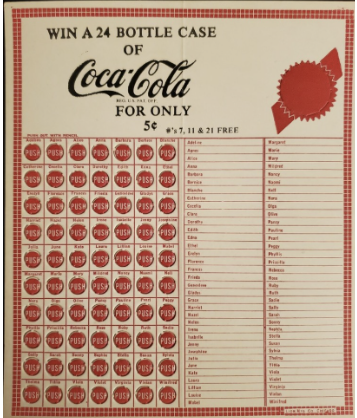
Example of a CocaCola punchboard. -
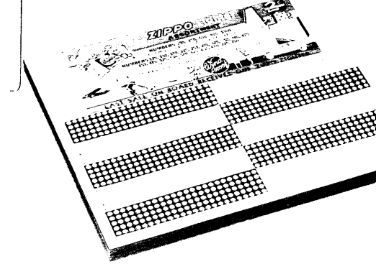
Zippo punchboard.
By the 1940's a new form of concealed prize gambling was gaining popularity. The pull-tab ticket (aka breakopen ticket, cherry bell, lucky 7, jar ticket, tip jar ticket). These were tickets with a hidden prize concealed behind a perforated window. They were sold from jars behind bars and store counters all over the country. The tickets would come in a randomized pack of a few thousand with a predetermined prize structure. Created via a complicated, multi-step printing process, the pulltab was much easier to play. Instead of a central board, individual tickets were sold to customers that they could open at their leisure. It became a social tavern game, much moreso than the punchboard. They and others advertised in publications such as Billboard magazine.
This new product came in "deals" or boxes of a specific number of tickets. The winners were predetermined amounts and randomized, so even the distributor didn't know where the winners were. Locations often keep track of how many large winners in each deal are left on the "flare" poster, usually attached to the dispensing machine. One of the more famous pulltab companies, Jar o Do was founded around this time. They and others advertised their wares, again in Billboard magazine.
-
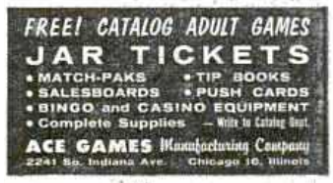
Magazine advertisement for pulltabs (jar-tickets). -
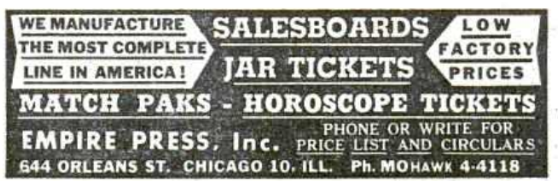
Magazine advertisement for pulltabs (jar-tickets).
These new tickets were sold in taverns across the country, especially in Wisconsin. The bartender became both the place to buy tickets and to redeem prizes. This inefficiency lead to the development of the pulltab dispensing machine. Bartenders were now only responsible for instant prize redemption. In 2023 Ducktabs became the first pulltab to offer automatic prize redemption on a payout machine via a unique code printed on each ticket. This unique code also enables us to run a player rewards program to encourage reporting of large winners, helping us keep in compliance with statute 100.16
The games remained widespread and popular, but over time, the rules began to splinter off state-by-state leading to where we are today. In 1982, Wisconsin added statute 100.16 (2), possibly due to a 1981 lawsuit over a promotional game Coca Cola was running, where you could win cash based on what was printed on the underside of the bottle cap.
This clarified the rules surrounding “selling with the pretense of a prize; in-pack chance promotion exception”, the statute reads:
(2) This section does not apply to an in-pack chance promotion if all of the following are met:
(a) Participation is available, free and without purchase of the package, from the retailer or by mail or toll-free telephone request to the sponsor for entry or for a game piece.
(b) The label of the promotional package and any related advertising clearly states any method of participation and the scheduled termination date of the promotion.
(c) The sponsor on request provides a retailer with a supply of entry forms or game pieces adequate to permit free participation in the promotion by the retailer's customers.
(d) The sponsor does not misrepresent a participant's chances of winning any prize.
(e) The sponsor randomly distributes all game pieces and maintains records of random distribution for at least one year after the termination date of the promotion.
(f) All prizes are randomly awarded if game pieces are not used in the promotion.
(g) The sponsor provides on request of a state agency a record of the names and addresses of all winners of prizes valued at $100 or more, if the request is made within one year after the termination date of the promotion.
This statute laid the groundworks for pulltab culture in Wisconsin taverns as we know it today. There are thousands of pulltab dispensing machines around the state. In fact, it's probably upwards of 10,000 machines by our estimate, including various gas stations and other non-bar locations. A notable inefficiency we noticed when we entered the market in 2022 was the promotional game payouts beind handled by staff on site such as a bartender.
Today, Ducktabs continues the tradition of legal Wisconsin pulltabs by closely adhering to the guidelines set out by the state. There are some unscrupulous operators that try to sell illegal pull-tabs obtained in Illinois or other states. But many tavern owners are realizing it is no longer cost-prohibitive to have legal pulltabs in their establishments. Look for the Ducktabs logo in your favorite tavern. We are proud to partner with local businesses to promote their products via coupons and advertising on our games, just like major brands did 100 years ago.
"Wisconsin's Cardboard Quack" has your back.
Sources: